.jpg)
- An automatic fire alarm system is designed to detect the unwanted presence of fire by monitoring environmental changes associated with combustion.
- Fire alarm system is either classified as automatically actuated, manually actuated, or both.
- It can be used to notify people to evacuate in the event of a fire or other emergency, to summon emergency services, and to prepare the structure and associated systems to control the spread of fire and smoke.
- There is 3 type of system:-
- Conventional
- Semi Addressable
- Fully Addressable
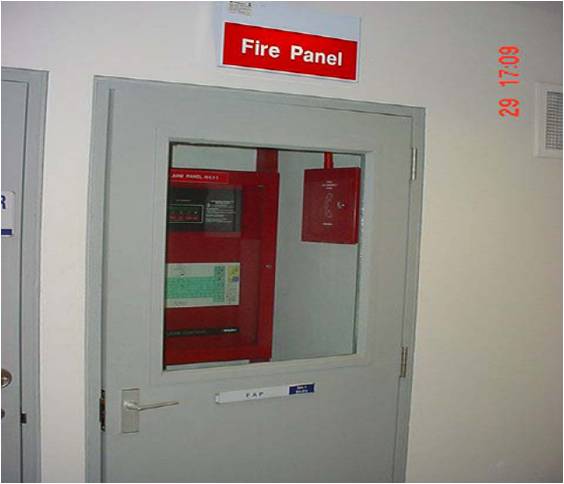
The addressable Fire Alarm Panel has installed.

- The CO Dioxide Fire Suppression System or CO2 System is an automatic extinguishing system to pull off the fire in the building.
- It's design to protect some special area inside the building such as LV or HT Switch Room, Transformer Room, MSB Room, or Genset Room.
- The CO2 System includes detectors, a control unit, agent storage cylinders, piping and discharge nozzles.
- It can discharge in automatic mode or manual mode depend on the situation.
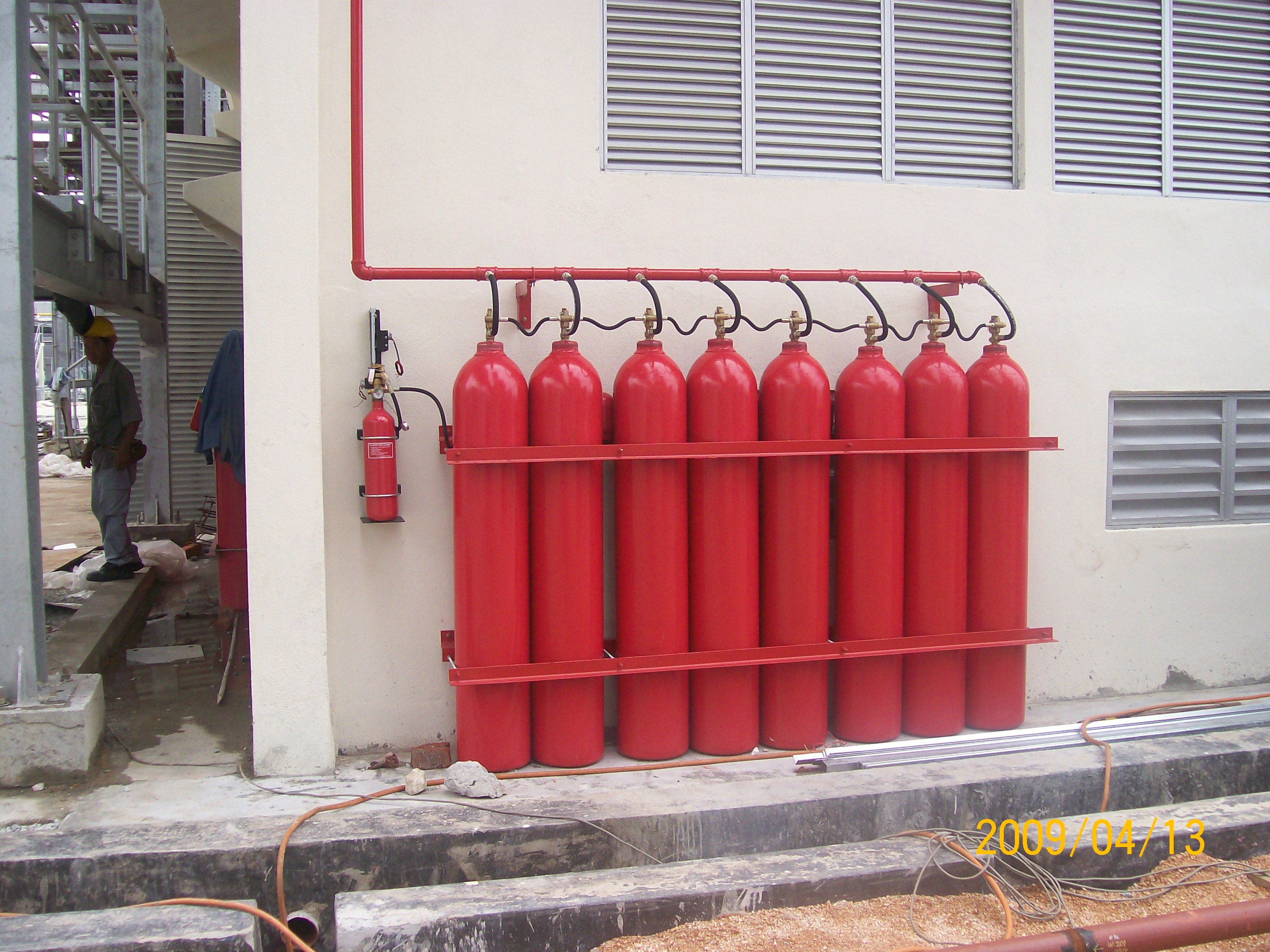 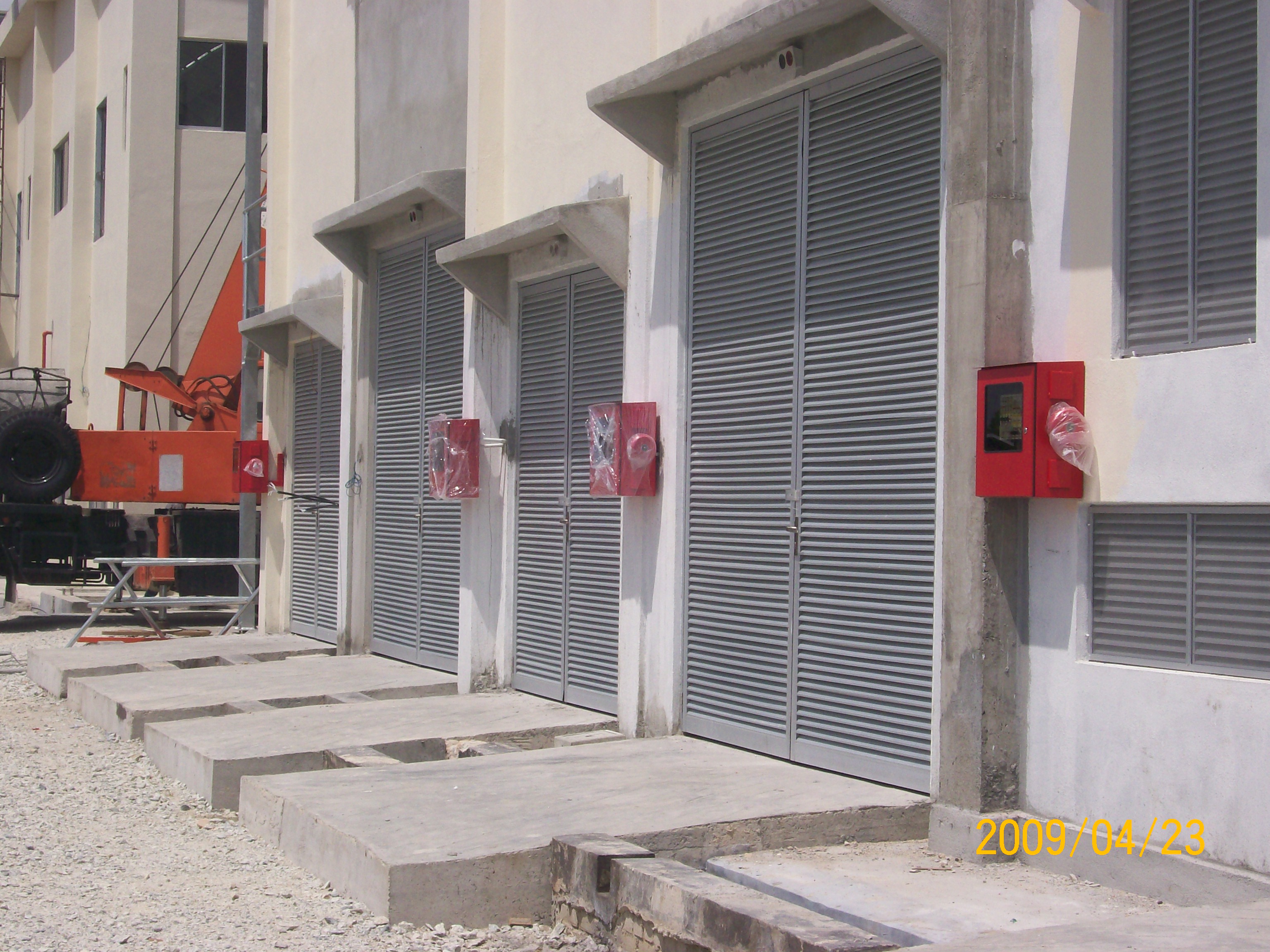
Pic : CO2 cylinder had installed with pilot cylinder. Pic : Control panel had installed outside of Elec. room.

- The Clean Agent System is an automatic extinguishing system to pull off the fire. It's come with some of the gas, like :
- FM 200
- FE-13
- Argonite
- Inergen
- The Clean Agent System are superior to basic water-based fire protection systems in many ways:
-
Electrically non conductive, and does not damage electronics—water is a great conductor and ruins electronics!
-
Is safe for people and can be used in occupied and unoccupied spaces.
-
Extinguishes a fire faster than water. Because they act quickly, clean agents greatly reduce the amount of smoke and soot damage caused by a fire.
-
Environmentally responsible.
-
Protects your high-valued assets—even collectibles and irreplaceable artifacts.
- The Clean Agent System includes detectors, a control unit, agent storage cylinders, piping and discharge nozzles.
- It can discharge in automatic mode or manual mode depend on the situation.

- Hose reel system consists of Hose reels (30m) fixed on specific locations of all floors connected to a Fire Pump Set.
- This System is a pressurized one with a sole purpose of fighting any fire that might occur until the Fire & Rescue Services arrive.
- A Fire pump set, complete with In and Out galvanized steel pipe work and expansion vessel will be provided for the Hose reel System.
- Two automatic electric driven pumps and diesel driven pump shall be provided to feed the hose reel system, one of the electric driven pump shall be as duty pump, and the second electric driven pump shall act as a booster pump where the water pressure in hose reel mains needs to be boosted.
- The diesel driven pump (standby pump) shall be so arranged that it will operate automatically on a failure for any reason of the electric driven pumps. All pumps shall be capable of being started and stopped manually. An audible and visual alarm shall be provided. Voltage supply shall be 415-480v / Three Phase / 50 Hz.
- Both electric and diesel driven pumps shall be sited in fire-protected positions and the electrical supply to them shall be an exclusive circuit with the cables following a route of negligible fire risk or will be provided with adequate protection.
- The electric driven pumps shall come into operation automatically on a drop in pressure or a flow of water. Both pumps shall be automatically primed at all times.
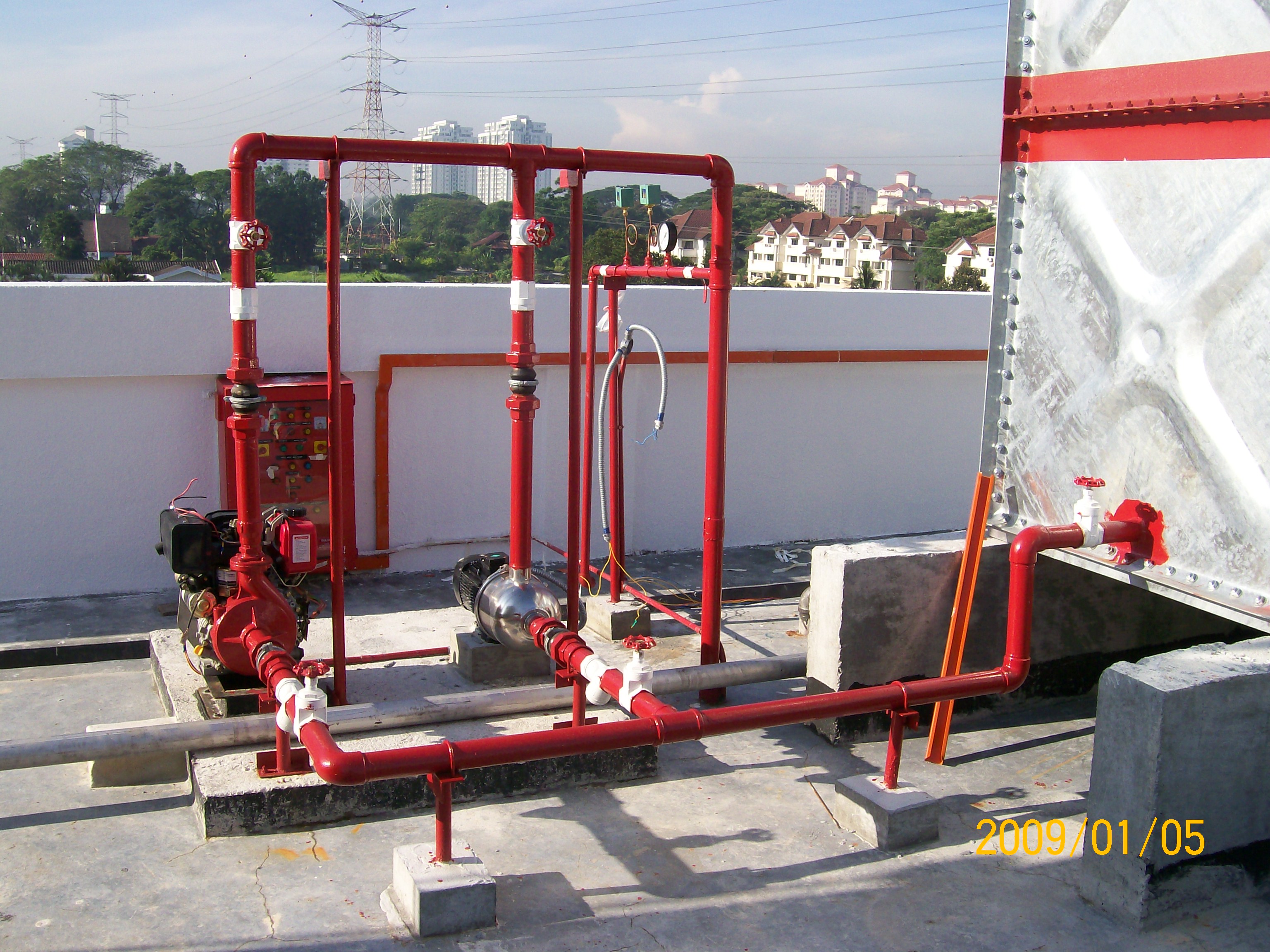
Installation of Hose Reel pumpset c/w water tank.

- A fire sprinkler system is an active fire protection measure, consisting of a water supply system, providing adequate pressure and flowrate to a water distribution piping system, onto which fire sprinklers are connected.
- Each closed-head sprinkler is held closed by either a heat-sensitive glass bulb or a two-part metal link held together with fusible alloy.
- The glass bulb or link applies pressure to a pip cap which acts as a plug which prevents water from flowing until the ambient temperature around the sprinkler reaches the design activation temperature of the individual sprinkler head. The number of sprinklers that operate is limited to only those near the fire, thereby maximizing the available water pressure over the point of fire origin.
- A sprinkler activation will do less damage than a fire department hose stream, which provide approximately 900 liters/min (250 US gallons/min).
- In addition, a sprinkler will usually activate between one and four minutes, whereas the fire department typically takes at least five minutes to arrive at the fire site after receiving an alarm, and an additional ten minutes to set up equipment and apply hose streams to the fire. This additional time can result in a much larger fire, requiring much more water to achieve extinguishment.
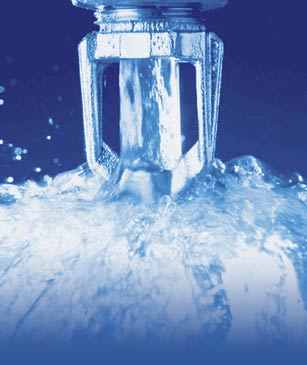
Detail of Sprinkler Head Burst

- A Wet riser is a main vertical pipe intended to distribute water to multiple levels of a building or structure as a component of the fire suppression systems.
- The pipe is maintained pressurize of water.
- The wet riser is the opposite of a "dry riser" or "empty standpipe" system where the pipes are empty of water for manual fire fighting operations.
- Wet risers have their own pumpset to pressurise the water inside the pipeline and the wet riser inlet box also prepared for fire engine to access.
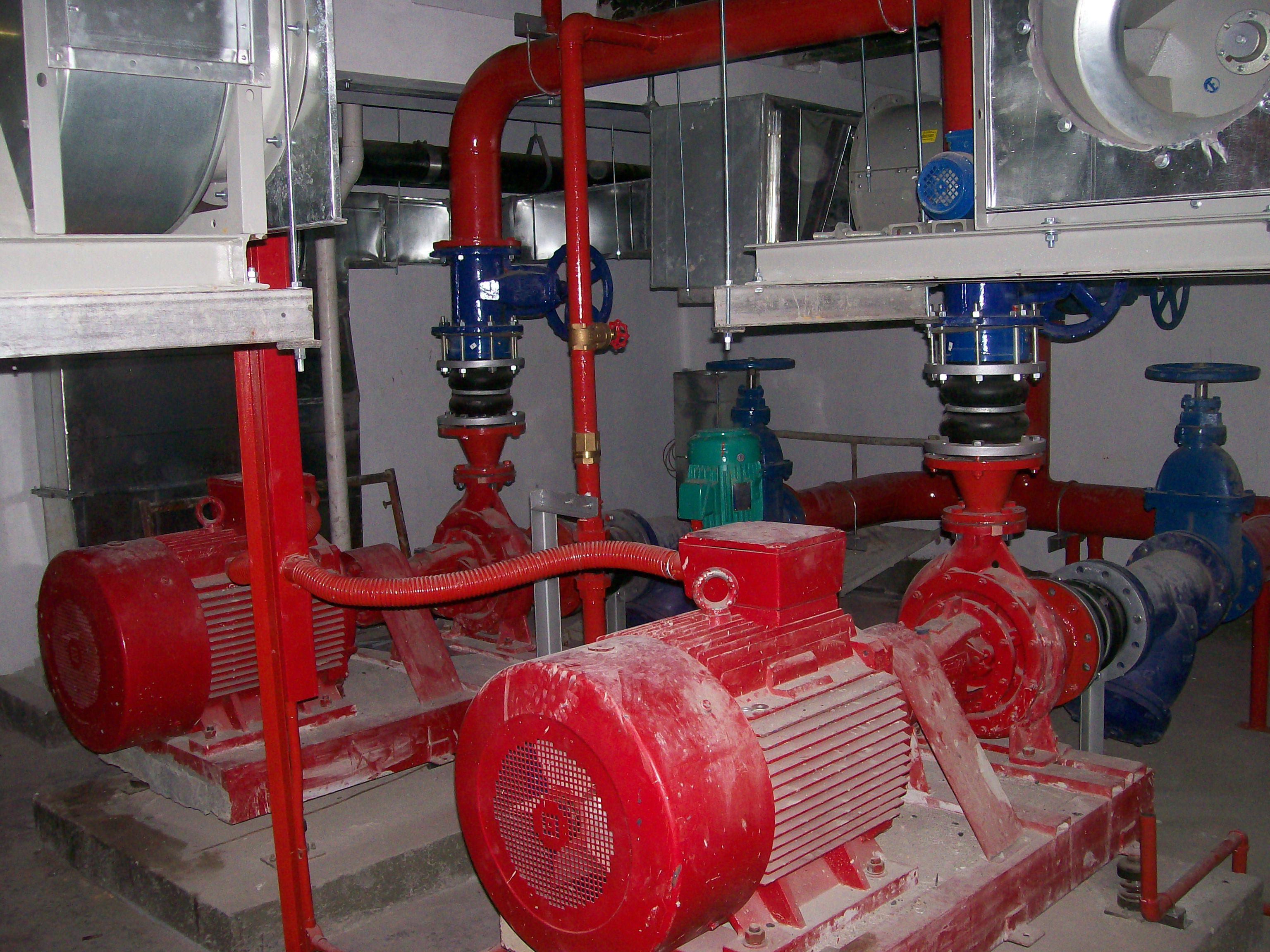
Wet riser pumpset had installed at Level 17A in Lot 163, Jalan Perak, Kuala Lumpur.

- A dry riser is a main vertical pipe intended to distribute water to multiple levels of a building or structure as a component of the fire suppression systems.
- The pipe is maintained empty of water.
- The dry riser is the opposite of a "wet riser" or "wet standpipe" system where the pipes are kept full of water for manual or automatic fire fighting operations.
- Dry risers have to have fire engine access within 18m of the dry riser inlet box.
- Depending on regional nomenclature, this may refer to a standpipe, intended to provide water to hose connections, or could refer to a vertical main pipe in an automatic dry pipe fire sprinkler system.
-
A dry standpipe includes a fire department connection which is an external access point at ground level through which water can be pumped from the fire department's fire engine pump to firefighters' hose attachments on each floor.

- Down comers are also a form of internal hydrant for the firemen to use and are always charged with water tank located at the top of a building but without any pumps.
- Down comers are only permitted for private residential buildings with open balcony approach where the topmost floor is not higher than 60 meters above the fire appliance access level and should be adopted for low cost flats only.
- Down comers system comprises a high level water storage tank discharging into 150mm diameter riser pipe with landing valves at each floor and to which canvas hose with nozzles can be connected to direct the water jet at the fire.
- No pumps are provided and therefore the system pressure is limited to the static pressure only.

- A fire hydrant is an above-ground connection that provides access to a water supply for the purpose of fighting fires.
- The water supply may be pressurized, as in the case of hydrants connected to water mains buried in the street, or unpressurized, as in the case of hydrants connected to nearby ponds or cisterns.
- Every hydrant has one or more outlets to which a fire hose may be connected. If the water supply is pressurized, the hydrant will also have one or more valves to regulate the water flow.
- In order to provide sufficient water for firefighting, hydrants are sized to provide a minimum flowrate of about 250 gallons per minute (945 liters per minute), although most hydrants can provide much more.
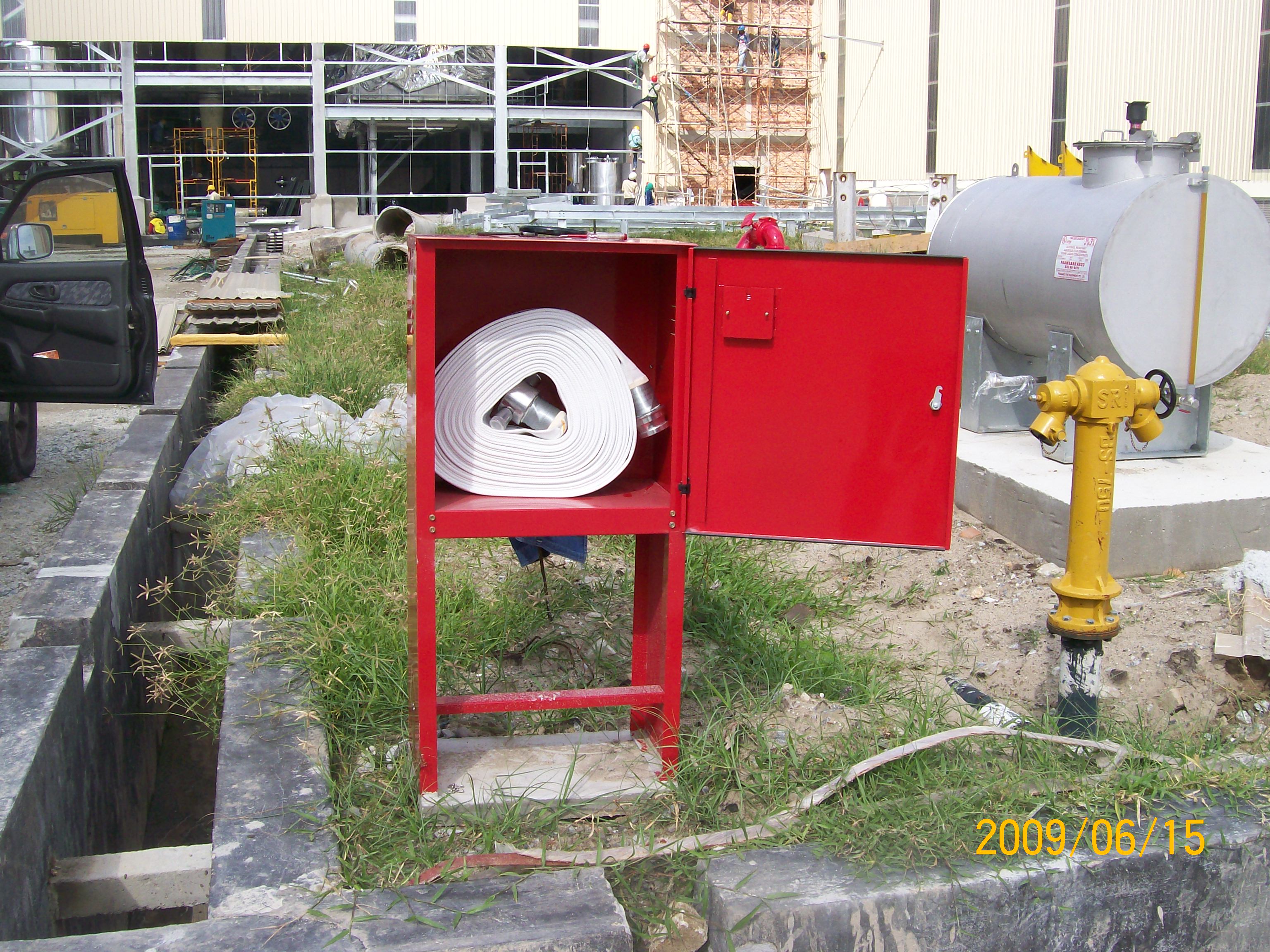
Canvas hose are kept inside the hydrant cabinet , beside is pillar hydrant.

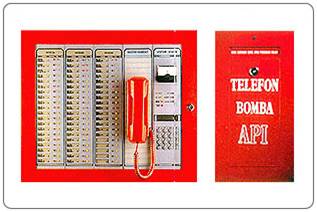
Firemen Intercom Control Panel c/w Remote Handset

- "Water spray" systems are operationally identical to a deluge system, but the piping and discharge nozzle spray patterns are designed to protect a uniquely configured hazard, usually being three dimensional components or equipment.
- The nozzles used may not be listed fire sprinklers, and are usually selected for a specific spray pattern to conform to the three dimensional nature of the hazard (e.g., typical spray patterns being oval, fan, full circle, narrow jet).
- Water spray systems can also be used externally on the surfaces of tanks containing flammable liquids or gases (such as hydrogen). Here the water spray is intended to cool the tank and its contents to prevent tank rupture/explosion (BLEVE) and fire spread.
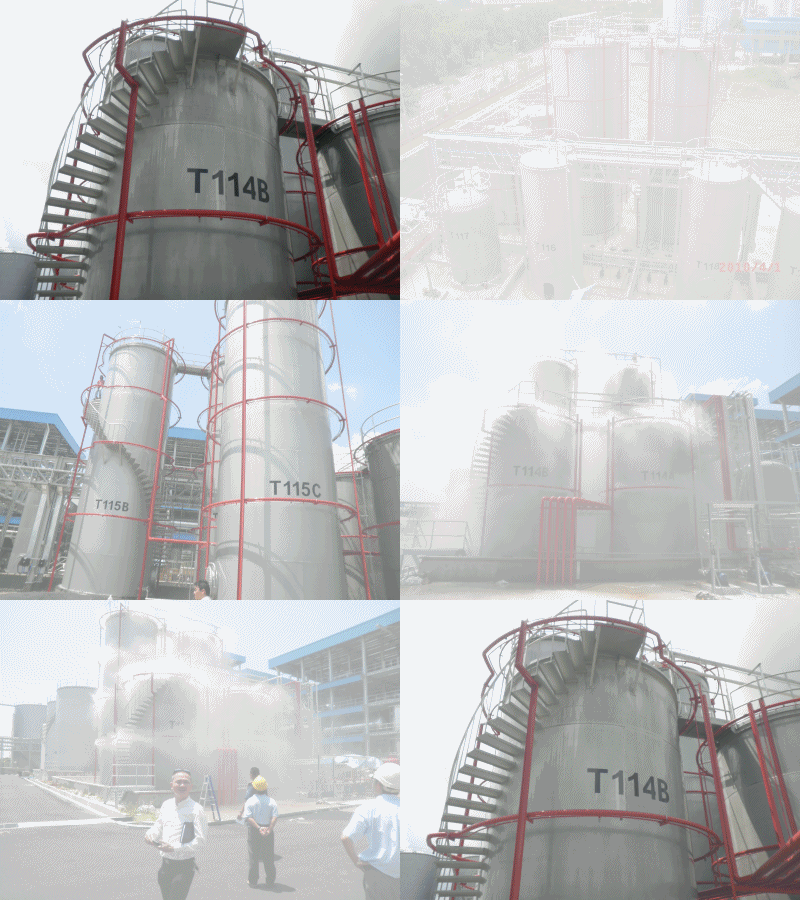
Water Spray Installation at Future Prelude, Pulau Indah.
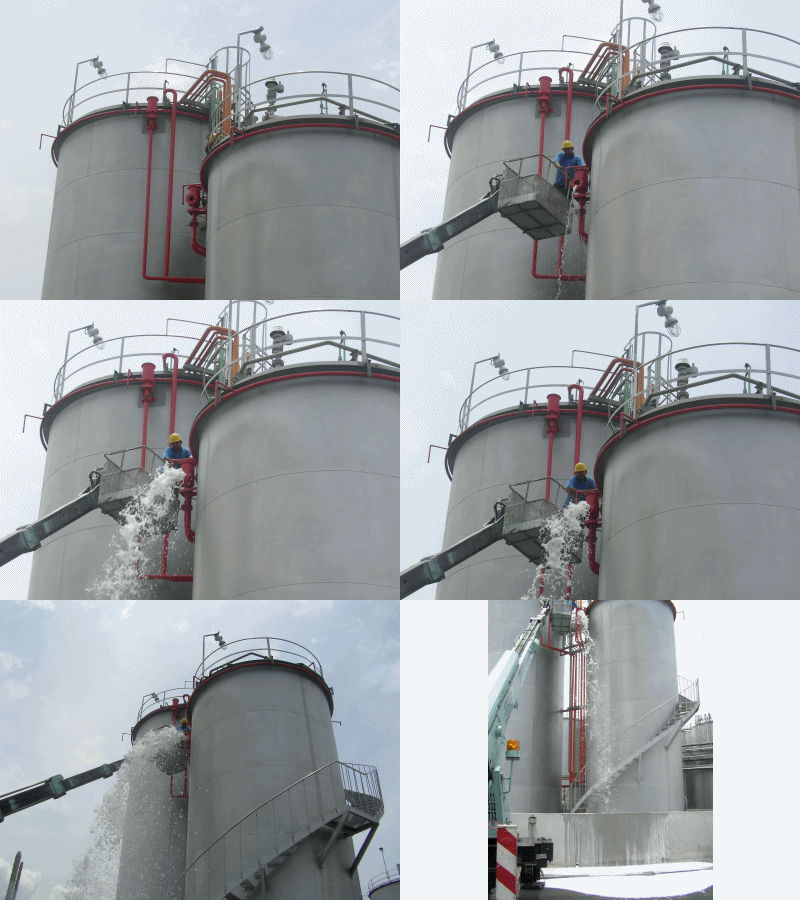
Testing & Commissioning on Foam Monitor in KL-Kepong Oleomas Sdn Bhd

Keluar Sign
- Keluar sign, in green colour (text) and white colour (background) is the sign to shown safety exit way out from the building during the fire situation.
- The Keluar sign will operated in 24/7 and support with power backup battery if the main power supply failure.
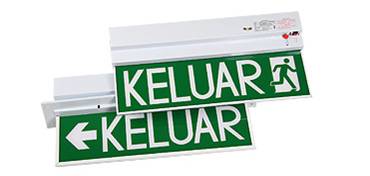
Keluar Sign
Emergency Light
- The emergency light which located inside the building will supply lighting during the fire or power supply failure.
- The emergency light come with backup battery will only function when the AC supply failure and continue to give light approximately 3 hours.
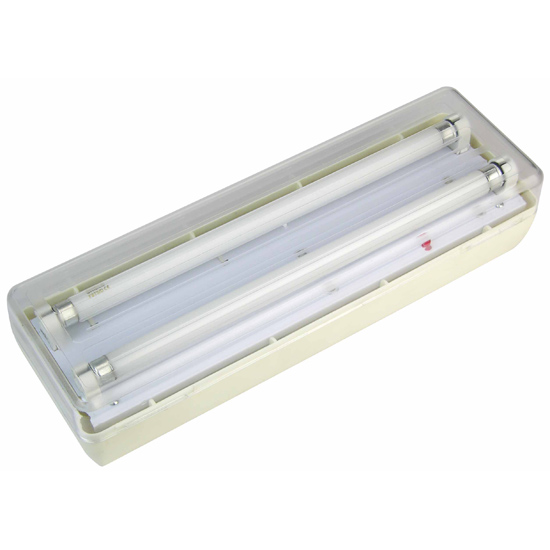
Emergency Light

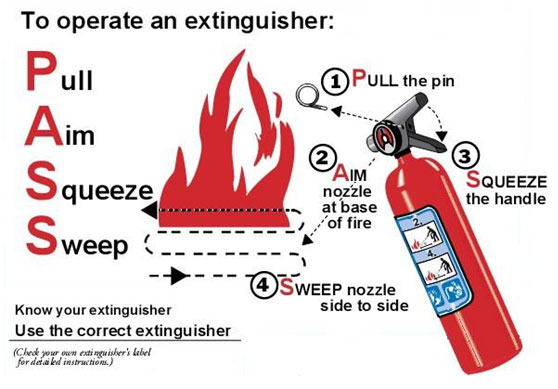
- The way we teach the public and our own members is to remember the simple acronym "PASS." Each letter in the word stands for a separate step in how to properly use a fire extinguisher.
- P - Pull the safety pin usually located around the handle of the extinguisher.
- A - Aim the fire extinguisher at the base of the fire.
- S - Squeeze the handle to begin to discharge the extinguisher.
- S - Sweep the extinguisher side to side while aiming at the base of the fire until the fire is out.
When using a fire extinguisher always keep your eyes on what is burning and keep the exit towards your back. In the event you cannot extinguish the fire you can simply walk backwards and out the exit. We also recommend having at-least 2 Fire Extinguishers ready for use in the event your Fire Extinguisher Runs out. Once again we cannot stress this enough but the best thing is to GET OUT and STAY OUT.
- There is a few type of fire extinguisher in the market, such as :-
- Dry Powder
- CO2
- Water
- Foam
- Wet Chemical
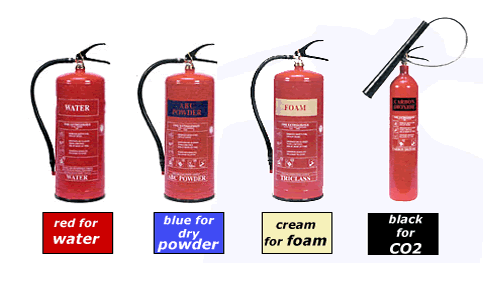
Type of Fire Extinguisher
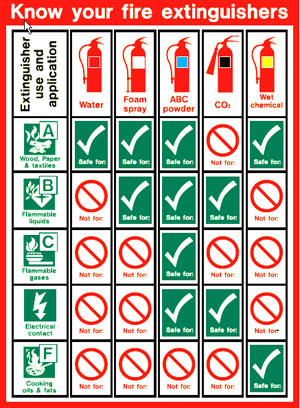
The Chart show on Type of Fire Extinguisher
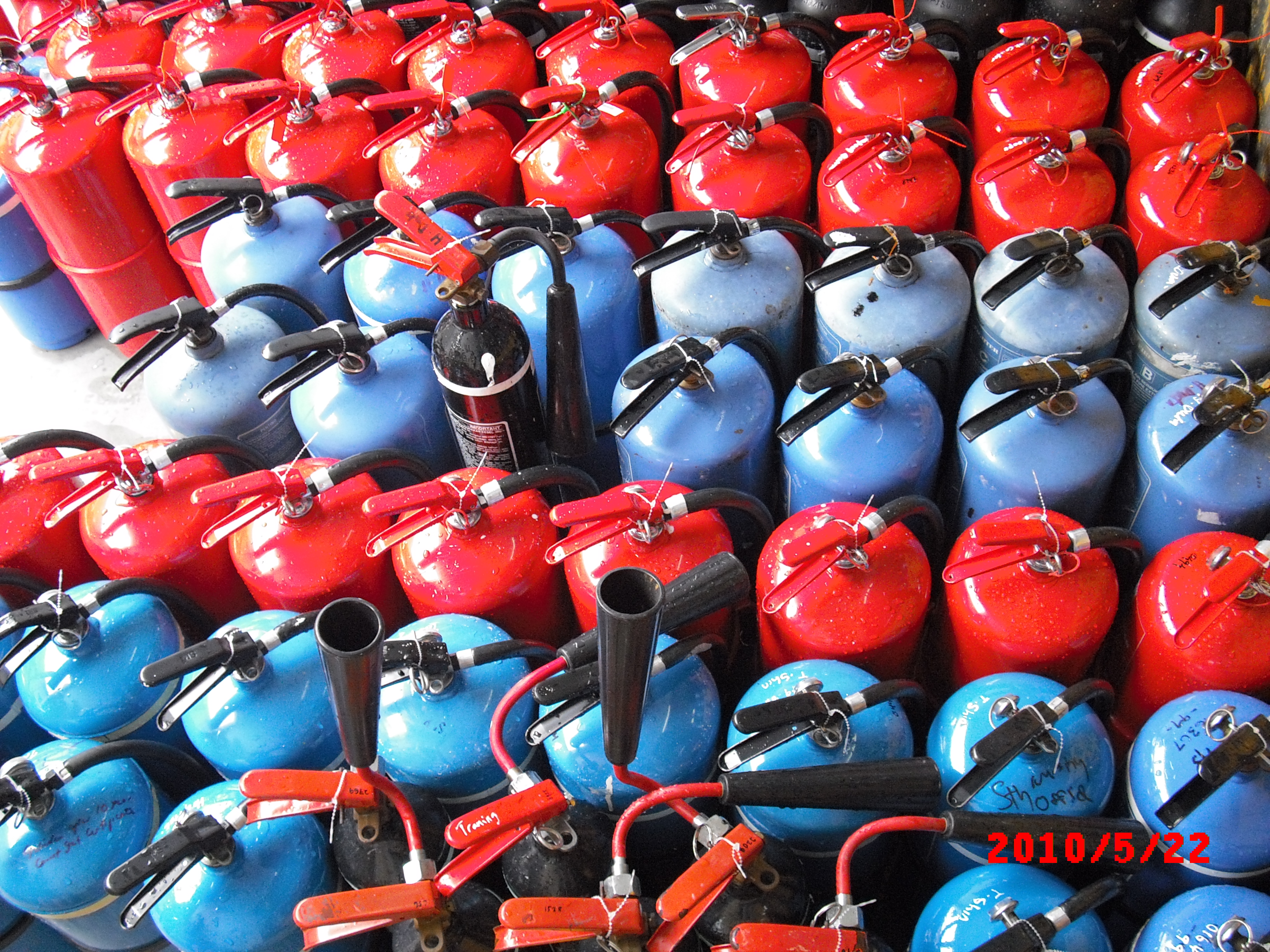
Dry Powder Fire Extinguisher
|